
“There is no longer any beauty except the struggle. Any work of art that lacks a sense of aggression can never be a masterpiece.”
Filippo Marinetti
Over the course of the last century, a sentiment has grown in the international realm which opposes itself to militant struggle as a means for progress. This current is simply a reformist, and new liberal trend which has sought to create change through stagnant parliamentary talking-shops, where only a temporary and insufficient compromise can be reached, where both parties are forced into agreeing on a resolution which is not satisfying for either faction involved, whether it be between our democratic & republican parties here at home in the United States, or nations which are at war abroad. In the modern regime, all forms of struggle which embody the “spirit of warfare” from the general strike & the class war, to the war between states, are utterly condemned as “destructive.”
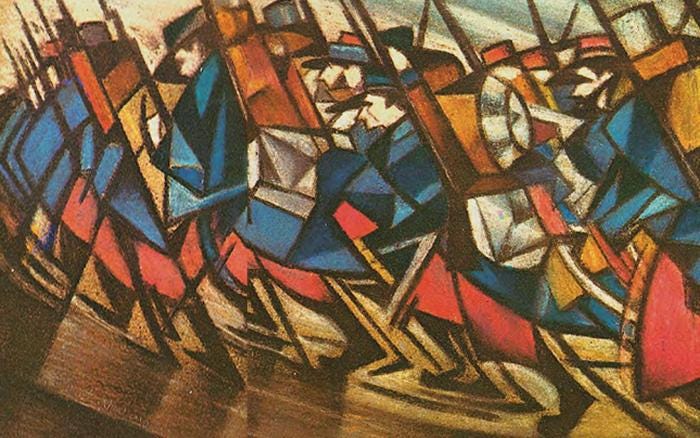
Christopher Richard Wynne Nevinson’s ‘Returning to the Trenches’, 1915.
Above all, Fascism, in so far as it considers and observes the future and the development of humanity quite apart from political considerations of the moment, believes neither in the possibility nor the utility of perpetual peace. It thus repudiates the doctrine of Pacifism — born of a renunciation of struggle and an act of cowardice in the face of sacrifice. War alone brings up to its highest tension all human energy and puts the stamp of nobility upon the people who have the courage to meet it. All other trials are substitutes, which never really put a man in front of himself in the alternative of life and death.
The Doctrine of fascism
When we look back into the past, we view the landscape of classical history littered with the militant and heroic struggles of war and social movements, which led the civilizations of history to eventually catapult themselves into modernity. Heroic militancy frequently found its popularity in the highest magnitude among the most progressive states of the ancient world, such as the Greek republics, which were formed on the basis of citizen armies [4]. It was within these citizen armies that art and philosophy reached their apexes, as all facets of society promoted the traditions of heroism of militancy. The “general strike” envisioned by trade-unionists of the early 20th century was a continuation of this tradition, which conceived of the productive classes organized as a popular army, separated from the parasitic classes such as the owners of large corporations (the “international bourgeois”) which did not have their interests in mind.
It has always been the attitude of “militant heroism” whether observed in the American Civil War of the 1860s, or the Women’s suffrage movement, or the Civil Rights Movement of the 1960s, or in the revolutionary strikes of the early 20th century, which led to social progress in every context. It was not the classical liberal characteristic of “compromise” which moved society forward anywhere at all, rather it was the classical Jacobin understanding of the mob, which curated the spirit of militant heroism and powerful working-class & underclass violence against the despotic regimes of their times. “Terror is the just application of virtue to a country’s most pressing needs.” The contemporary international pressures to arrange a “land concession” between Ukraine and Russia are a perfect illustration of the modern shy avoidance of militant struggle, which results in nothing of value, and would only function to the detriment of both nations in the long-term. Any compromise/concession between Russia & Ukraine in this war is bound to only heighten tensions in the long-term, extending the duration of this international conflict unnecessarily.
Let us briefly entertain the notion that some form of concession is reached in the coming months: It is extremely predictable that Ukraine will grow resentful as it will inevitably yearn for its stolen land, as all nations do which have lost their land in wartime. On the other hand, the Eurasianist [1][2] Russian Confederation will view its expansionist project as having been impeded by a compromise, as it is already demanding more land to be ceded to the Russian Confederation for the war to be brought to an end [3]. Russia will become bitter over the impediment to its expansionist foreign policy, and the war will erupt again in the future. In almost all instances, spineless and struggleless compromise can only bring a prolonged need for struggle later on, which will cost more resources, more time and more lives.
Liberal & Anarchist Pacifism
Modern liberalism & anarchism feel a special contempt for the “heroic militancy” which formerly moved society forward, while at the same time pronouncing their unwavering support for a so-called liberal progressivism, accompanied by a highly inconsistent pacifism.
Neoliberalism, an ideology of the ruling class, sees war as costly, as the ruling-class, motivated by the profit incentive, sees an interest in war only when it benefits the ruling class. This is the precise reason why the leaders of the modern world proclaim a staunch anti-war sentiment at times, becoming cowardly, servile, and pacifist, yet at other times when war is financially beneficial, and not too costly, they will not hesitate to send working men to the battlefield. The path which pursues the least amount of warfare is generally that which is the most beneficial to the ruling-class, as struggle for the sake of progress and social development alone has no beneficial end for finances. The lazy bourgeois intelligentsia on the other hand, have no interest in the developments of warfare either, seeking rather to advance through endless debate and abstract thought. These two factions of the ruling-class are the most consistently pacifist: the intelligentsia who deals purely in abstractions and does not know the struggles of the laborer, and the large businessman who knows just as much of the labor as the intelligentsia does, having no conception of servitude or heroic militancy for a common struggle, only serving their individual interest, notably similar to egoist anarchists who view the individual as unrelated to and isolated from any social interest.
You will not find such mass anti-militarism among the standard ranks of the productive classes— which will only ever become anti-militarist in the context of opposing the ruling classes utilization of the military for its own ends— but will never become anti-militarist simply on the basis of opposing war on principle. This was notably the case in the hard-hat riots during the Vietnam War, a staunchly pro-war movement dominantly composed of the productive classes. The life of the laborer resembles the life of the soldier in heavy imbrication, as noted by Pierre-Joseph Proudhon:
“Finally, workers’ companies appear, true armies of the Revolution, where the worker, like the soldier in the battalion, maneuvers with the precision of his machines; where thousands of intelligent and proud wills, merging into a superior will, like the arms they animate, generate through their harmony a collective force greater than their very multitude” [6].
The point which is being formulated by Proudhon here is that the same spirit which has fueled the vigor of the soldier simultaneously fuels the producers of industry, propelling them into motion.
War in Social Development
This pacifism and opposition to political struggle beyond that of the ballot-box is corrosive. Antagonism between principles is how society has always developed, and without it, would cease to live and develop in any sort of productive manner. As French thinker, Edouard Berth states:
“If peace is ever possible, it must be conceived otherwise than as a negation of war; it will only be a transformation of war, a new form of that eternal antagonism which is the law of the world, both social and natural … peace is impossible, or, if it were possible, it would be for men synonymous with immobility, stagnation, atony and death” [5].
The principle of progress through antagonism which characterizes human civilization and human struggle, however, is not a principle which is intended to produce simply chaos and unending enmity. The clash brought about through war is intended to produce an end-result superior to what was known previously. Warfare is not a perfect mechanism, and sometimes the victor brings about in fact worse conditions than what was dominant previously. However, the innovation of war and militant heroism is the single method of conflict resolution which has pushed the human race the farthest. The shedding of feudalism was not brought about through peaceful reform, and the advent of a possible future socialism will not be brought about as our contemporary democratic socialists envision. The only concessions which the ruling class ever gave the productive classes throughout the last few centuries were through mass action, not through begging and groveling the owners of large industry to institute social reform.
If war between states as the means of civilizational change were ever to disappear, (which as long as there are separate nations it will not) it would be substituted by some other form of struggle, which society would run to in an effort to create motion and to maintain its life. This fact has been exemplified in the concept of class warfare which was utilized by some socialist regimes throughout the twentieth century to reinvigorate society in a new and dynamic manner. The basis of the class war was generally the war of the worker & producer against the large capitalists and oligarchs in most practical implementations of socialism throughout Eastern Europe, Asia & South America.
Militant struggle, whether international (between states) or domestic (between social & economic groups) is the determining agent which brings a conclusive stamp on which faction has the due right to political power, as history, regardless of whether or not you like it, cuts the cake decidedly based on which diametrically opposed faction in a conflict emerged as the winner, as the saying goes:
“The history is right perhaps, but let us not forget, it was written by the victors [7].”
Reform did not create human civilization. It is irrefutably warfare which created peoples, borders, states, classes, progress, and it is warfare which brings mankind out of the nasty and brutish state of nature, and into the beautiful and supranatural organ of what we know as “social order” which humanity lives in today. To demand the end to war is to demand an end to what brought form to the world we have grown in for thousands of years, and therefore a return to chaos which is the only inevitable outcome of a struggleless stagnant society, a return to primordial formlessness, which we know through the age-old saying:
Terra autem erat inanis et vacua.
- Russia adopts new anti-West foreign policy strategy – DW – 03/31/2023 (archive.org)
- The Concept of the Foreign Policy of the Russian Federation | Russian Mission (archive.org)
- Putin demands more land to end Ukraine war, terms Kyiv rejects as ‘complete sham’ | CNN
- Hoplite – World History Encyclopedia
- Berth, Édouard. Les nouveaux aspects du socialisme. 1908.
- Proudhon, Pierre-Joseph. The General Idea of the Revolution in the 19th Century. Translated by John Beverly Robinson, 1923.
- Histoire de la royauté: considérée dans ses origines, jusqu’à la formation … – Alexis Guignard de Saint-Priest – Google Books
 The Seamusite Fascisti